
1Department of Computer Science, College of Computer, Qas
sim University, Buraydah, Saudi Arabia.
2Department of Computer Science, Artificial intelligent Pro
gram, College of Computer, Qassim University, Buraydah, Saudi
Arabia.
*Corresponding author: Sultan Alsamaani
Department of Computer Science, College of Computer, Qassim
University, Buraydah, Saudi Arabia.
Email: smartcsharp@gmail.com
Received: Feb 16, 2026
Accepted: Mar 23, 2026
Published Online: Mar 30, 2026
Journal: Journal of Artificial Intelligence & Robotics
Copyright: © Alsamaani S (2026). . This Article is distributed under the terms of Creative Commons Attribution 4.0 International License.
Citation: Alsamaani S, Alshammasi M, Alrumaykhani T, Aladwani A, Hassan N, et al. Research risks and challenges in artificial intelligence era: Ethical, methodological, and socio-structural implications for academic research. J Artif Intell Robot. 2026; 3(1): 1039.
The rapid integration of Artificial Intelligence (AI), particularly generative models and large language models, is fundamentally reshaping contemporary academic research. While AI offers unprecedented capabilities for data analysis, automation, and knowledge discovery, its widespread adoption introduces significant ethical, methodological, and structural risks that may undermine research integrity and epistemic reliability. This study systematically examines AI-related risks across three dimensions: (1) technical and methodological risks, including algorithmic bias, data contamination, and opacity; (2) integrity and ethical risks, such as authorship ambiguity, AI-assisted plagiarism, and erosion of critical thinking; and (3) socio-structural risks, including research power centralization and dual-use concerns. A quantitative cross-sectional survey (N=50) involving graduate students and academic researchers in Saudi Arabia was conducted to assess AI usage patterns, ethical perceptions, and trust dynamics. The findings reveal a strong association between AI familiarity and adoption, alongside near-universal agreement on the necessity of human oversight and stricter ethical governance. The study concludes that AI should not be restricted but governed through robust institutional policies, ethical frameworks, and enhanced AI literacy to ensure responsible and sustainable integration into academic research.
Keywords: Artificial intelligence ethics; Research integrity; Academic governance; Generative AI; Human oversight; Research ethics; Trust in technology.
The advent of sophisticated Artificial Intelligence (AI), particularly generative models and Large Language Models (LLMs), is heralding a transformative period for global higher education and academic research. This paradigm shift, often likened to a new industrial revolution [1], promises to democratize data analysis, accelerate discovery, and personalize the educational journey [2,3]. Powerful AI systems are poised to augment human intellect, offering tools that can synthesize vast corpora of literature, generate novel hypotheses, and even assist in drafting research manuscripts [4]. The potential for AI to contribute to global goals, such as Sustainable Development Goal 4 (SDG4) for quality education, is significant, suggesting a future of more inclusive and effective learning environments [5].
However, this rapid integration of AI into the academic fabric is not without profound risks and challenges. The very tools designed to augment human capability are simultaneously introducing novel vulnerabilities that threaten the core principles of scholarly integrity, ethical conduct, and the production of valid, reliable knowledge. The “black-box” nature of many complex AI models, a central concern in the quest for Explainable AI (XAI), poses a fundamental challenge to research validation and reproducibility [1,2]. When the reasoning behind an AI-generated conclusion is opaque, the traditional peer-review process is compromised, creating a crisis of interpretability and trust [6].
A primary cluster of challenges revolves around research ethics and integrity. The ease with which AI can generate coherent text, and data raises acute concerns about plagiarism, authorship, and the authenticity of scholarly work [3,7]. Students and researchers may be tempted to use generative AI like ChatGPT to produce assignments or research components without adequate critical engagement or transparent disclosure, blurring the lines of original contribution [4,8]. This directly challenges long-standing scientific research ethics, forcing a re-evaluation of concepts like originality and intellectual labor [3,9]. Furthermore, AI systems trained on historical data can perpetuate and even amplify existing societal biases, leading to discriminatory outcomes and flawed research findings that reinforce social inequalities [1,10]. The challenges of adhering to strict ethical standards in AI application development are already evident among research communities, highlighting a gap between theoretical principles and practical implementation [3].
Methodological rigor is another area under threat. The uncritical adoption of AI-driven “big data” analytics can lead to a reliance on correlation over causation, potentially undermining the theoretical foundations of disciplines, particularly in the social sciences and humanities where qualitative depth is paramount [5,11]. The push towards data-intensive science must be balanced with efforts to transform data into meaningful, contextual knowledge, a challenge central to the vision of AI 2.0 [6]. Additionally, the immense computational resources required for state-of-the-art AI research create barriers to entry, potentially centralizing innovation within a few well-funded institutions and exacerbating global digital divides [1,2].
This paper argues that the academic community stands at a critical juncture. To harness the transformative potential of AI while safeguarding the foundational values of research, a proactive and multidisciplinary response is essential. This entails developing robust ethical frameworks, promoting algorithmic transparency through XAI, fostering AI literacy among students and researchers, and re-evaluating institutional policies on authorship and assessment [4,7,8].
By systematically examining the specific risks posed by AI, from data privacy and bias to the erosion of methodological rigor, this study aims to contribute to a roadmap for navigating the AI era responsibly. The goal is not to stifle innovation but to ensure that the future of research, as it is reshaped by AI, remains equitable, ethical, and epistemologically sound.
Research gap and contribution
Despite the growing body of literature addressing Artificial Intelligence in education and research, existing studies predominantly focus either on technological capabilities or ethical principles in isolation. There remains a lack of empirically grounded research that simultaneously integrates ethical, methodological, and socio-structural risks within a unified analytical framework, particularly in the context of active researcher behavior and perceptions. Moreover, few studies quantitatively examine how AI familiarity, publication pressure, and disciplinary context interact to shape ethical concerns. This study addresses these gaps by providing an integrated risk taxonomy supported by empirical survey data, thereby contributing both conceptual clarity and practical insights for policymakers, institutions, and researchers navigating AI enabled scholarship.
Conceptual framework: AI risks across the research lifecycle
This study adopts a lifecycle-oriented conceptual framework that situates Artificial Intelligence risks across key stages of academic research: problem formulation, data collection, analysis, interpretation, and dissemination. AI-related risks are classified into three interdependent domains: technical methodological risks, integrity–ethical risks, and socio structural risks. These domains interact dynamically, such that technical opacity may amplify ethical ambiguity, while institutional pressures may intensify uncritical AI adoption. By framing AI risks as systemic rather than isolated issues, this framework provides an integrative lens for analyzing how AI reshapes research practices, governance, and epistemic trust.
AI is no longer an area of research but an engine of enterprise for mission-critical applications and systems. Supported by a perfect storm of large amounts of data, big computing, and open-source platforms, machine learning systems have become increasingly common. Yet increasingly sophisticated systems grapple with emerging requirements like secure, robust, and explainable AI and the ability to process data at scales larger than Moore’s law suggests. This paper highlights opportunities for future research in task-specific hardware, modular AI, reliable AI systems, and edge-cloud architectures [1].
In [2], a literature review centered around human-centered smart societies powered by state-of-the-art technologies such as XAI, IoT, cyber-physical systems and digital twins. Relative to Industry 4.0 which was more focused on mass production and automation, Industry 5.0 is more connected to human-machine collaboration, mass personalization of products and services, and cross-domain advanced connectivity for health care, smart cities, autonomous driving and more. Research challenges in the field involve data interoperability, security and privacy in a networked environment and addressing the black-box nature of AI for transparency and trustworthy intelligent decision making While prior studies highlight isolated ethical concerns or technical limitations, literature lacks a cohesive synthesis that frames AI risks as interconnected challenges affecting the entire research lifecycle. Furthermore, existing research rarely operationalizes these risks through measurable constructions linked to researcher behavior. By synthesizing insights from explainable AI, research ethics, and higher education governance, this study positions itself at the intersection of theory and practice, offering an empirically informed perspective that extends beyond normative discussions.
In [3], researchers operate under the assumption that AI applications exist that enhance reliability and effectiveness in research but also pose extreme ethical concerns for all researchers but especially those in Algeria. It demonstrates that artificial intelligence applications improve optimal speed data collection, translation access and creation, and knowledge acquisition and creation; however, the most significant ethical concerns in relative opposition to these findings are data privacy breaches, scientific plagiarism, bias and AI-generated responses, and lack of regulations and oversight. Ultimately, this literature review finds that overwhelming populations of researchers in Algeria are relatively uninformed about ethical concerns of AI applications relative to their research outcomes but simultaneously, laws and regulations established in the wake of such scientific AI applications are behind the times to better protect research in relative compliance with invention speed where the web and AI applications can outpace legislation.
In [4], C.K.Y. Chan and W. Hu and et al conducted within this document, university students possess an overall favorable perception of generative AI tools, understanding their advantages for personalized learning, writing support and research assistance but simultaneously, educators are cautioned by students’ concerns for inaccuracy, opacity, privacy, plagiarism, reduced critical thinking abilities, and ambiguous administrative responses. Thus, the literature review supports a need for specific AI literacy instruction and comprehensive policies for responsible, ethical and efficient implementation of GenAI in the university setting.
According to [5], the study is relative to the ethical considerations of AI in education and how such technology should be ethically approached relative to UNESCO’s SDG4 quality and inclusive education. Where AI offers personalized education, teaching support to teachers, and reduces a lot of the tedious administrative work that comes with education, the literature review shows how AI lacks humane empathy, creates additional bias, presents data privacy and protection concerns, and resources are not equitable unless socioeconomic equity is addressed - and likely, regulated against - in an AI-centered population. Ultimately, interdisciplinary guidelines, teacher preparation, and an appropriate ethical framework are needed to better support AI as a better solution for educational outcomes without sacrificing humanity.
Y. Zhuang and et al [6], contains the state of the art in AI, determining when rule-based reasoning is not enough and noting the transition to statistical machine learning to deep learning architectures. The authors note that a hybrid approach between data-driven and human-based approaches results in more explainable, robust, generalized AI solutions and better for NLP, multimedia, and knowledge engineering. Therefore, the gaps in the literature going forward are explainability of AI, optimal fusion of multi-modal data, creative AI, and human machine partnerships for knowledge extraction from big data.
Adiguzel T and et al [7], reported that artificial intelligence, particularly chatbots like ChatGPT, is transforming education by fostering personalized learning experiences, automated assessment, and responsive, supportive learning environments. The advantages of implementation observed so far are enhanced student engagement, tailored support for varied learning and development needs, and teachers operating with increased efficiency through technology-assisted teaching. However, major ethical considerations and practical concerns emerge relating to bias, privacy, academic honesty, teacher training and access equity and inclusion that require the implementation of supported frameworks for responsible use.
Explicit research questions
Research Questions
This study is guided by the following research questions:
• RQ1: To what extent do academic researchers adopt AI tools in their research activities?
• RQ2: How does familiarity with AI technologies influence perceptions of ethical and integrity-related risks?
• RQ3: What relationship exists between AI usage and demands for human oversight and ethical governance?
• RQ4: How do researchers who refrain from AI use conceptualized risks to research integrity and creativity?
A quantitative approach was chosen to measure the prevalence of AI adoption and statistically correlate it with ethical concerns.
1. Design: A cross-sectional survey utilizing a Likert scale (1-Strongly Disagree to 5-Strongly Agree) with multiple choice items.
2. Participants and data collection: The sample was 50 participants and includes graduate students and academics researchers from different majors. We chose a convenience sample which can easily reach the participants. We collect the results during November 2025, using an online survey distributed via WhatsApp groups.
• Survey instrument validity: The survey instrument was developed based on constructs identified in prior literature on AI ethics, research integrity, and technology adoption. Content validity was ensured through alignment with established ethical risk categories. Items were reviewed for clarity and relevance prior to distribution. While formal psychometric validation was beyond the scope of this exploratory study, internal consistency was examined to ensure coherence across thematic dimensions.
3. Analysis: Descriptive statistics (mean, frequency), Chi-square tests to assess discrepancies across disciplines, and multiple regression to identify factors (e.g., career stage, pressure to publish) that predict concerns with integrity.
• While the study provides valuable insights, several limitations should be acknowledged. The sample size and convenience sampling approach limit statistical generalizability. Additionally, reliance on self-reported perceptions may be influenced by social desirability bias. However, as an exploratory investigation into an emerging phenomenon, the study establishes a foundation for future large-scale and longitudinal research.
4. Ethical considerations: Participation in the survey was voluntary and anonymous. No personally identifiable information was collected, and respondents were informed of the study’s academic purpose. The research adhered to standard ethical principles for social science research, including informed consent, confidentiality, and responsible data handling.
1. The findings align with prior research indicating that AI adoption in academia is accompanied by persistent trust deficits. Unlike purely technical evaluations, this study demonstrates that ethical skepticism is shared across both AI users and non-users, reinforcing the argument that governance, not prohibition, is the central challenge.
2. Importantly, the perception that AI reliance weakens creative and critical thinking underscores a broader epistemological concern: the risk that efficiency-driven research cultures may privilege output over understanding. This raises fundamental questions about the future role of human judgment in knowledge production, particularly in fields where interpretation and contextual reasoning are essential.
3. From an institutional perspective, the results highlight the inadequacy of informal or ad hoc AI usage norms. The near unanimous call for human oversight reflects a collective demand for structured policies that clarify authorship responsibility, acceptable AI assistance, and accountability mechanisms.
4. Statistical tests indicated an association between familiarity with AI tools and their use in academic research. The results showed that 80% of researchers with high confidence in their AI knowledge (who responded ‘strongly agree’) had already moved to the practical application stage and used AI in their research.
5. On the other hand, ‘ethical awareness’ emerged among those with neutral technical knowledge. All 100% of this group believed that stringent ethical rules and frameworks are necessary and that human monitoring is still very important. This shows that people will only embrace this technology if there are controls in place to make sure the results are correct.
6. As for those who do not use technology, their responses reflected ‘legitimate concerns’ related to the core of scientific research. The vast majority (95%) believed that AI threatens academic integrity, and they unanimously (100%) agreed on the lack of awareness among researchers regarding the limitations of these tools, while also unequivocally (100%) emphasizing the imperative of human supervision. These “trust gap” findings strongly confirm concerns raised in previous studies. For example, the results, indicating that 95% of participants are concerned about research integrity, align with Chan’s findings [4], although they recognize the benefits of AI, the academic community remains concerned about errors and plagiarism. Furthermore, the collective call for human oversight in our study reinforces the findings of Adegüzel et al. [7], who emphasized that the absence of strong ethical frameworks makes the integration of AI a significant threat to academic integrity. These results indicate that the ‘trust gap’ remains the biggest obstacle to a full shift towards research automation among a wide segment of traditional researchers.”
7. To enhance analytical rigor, results are interpreted through comparative group analysis (AI users vs. non users) and contextualized against existing empirical findings. Percentages are supplemented with interpretive explanations to clarify their implications for research governance and ethical decision-making 80% of those who answered the question “I am familiar with the concept of Artificial Intelligence” strongly agree with Figure 1.
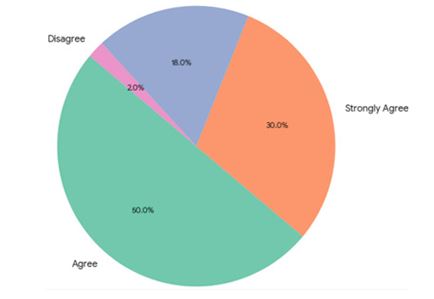
8. All neutral respondents who answered “I am familiar with the concept of Artificial Intelligence” agreed (100%) with either “a” or “strongly agree” on the following statements:
a. There should be stricter ethical guidelines for using AI in research.
b. Human oversight is essential when using AI in the research process.
9. All those who have never used artificial intelligence in academic research answered with either:
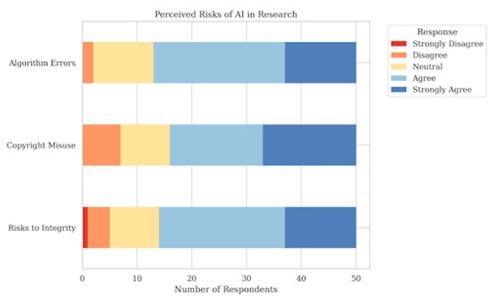
a. 95% agree or strongly agree with the statement “AI poses significant risks to research integrity and accuracy”, see Figure 2.
b. 100% agree or strongly agree with the statement “Researchers do not always understand the limitations of the AI tools they use”.
c. 100% agree or strongly agree with the statement “Human oversight is essential when using AI in the research process”.
10. The stacked bar graph shows that the majority responded with “agree” and “strongly agree” across all risk categories. This indicates skepticism about trust in AI algorithms and concerns that their use could negatively impact academic ethics, particularly regarding data output and the validity of results.
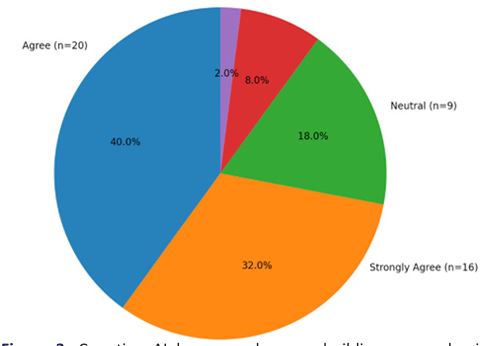
11. 73% of the participants of the survey agreed on the (Overreliance on AI weakens by researchers on building academic research weakens their ability in creative thinking) Figure 3 highlights the concern of weakens their ability in creative thinking.
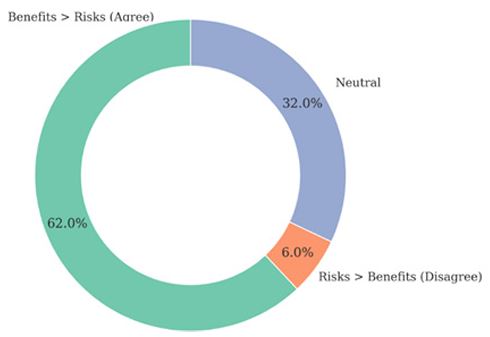
12. A small percentage of participants response that there are no benefits to using artificial intelligence compared to its risks.
13. The convergence of high AI familiarity with increased demand for ethical oversight suggests that knowledge does not lead to blind trust, but rather to heightened critical awareness. This counters assumptions that resistance to AI stems from technological ignorance and instead positions ethical concern as a marker of research maturity.
The lesson learned from the survey:
Knowledge leads to conclusion: Those who are confident in their knowledge use the tool.
Neutral does not mean clueless: Even those who are «neutral» demand ethical strictness.
Resistance stems from concern: Refusing to use technology (among no AI users) is not a rejection of progress, but rather a fear for the “integrity of research”.
Implications for research governance
The findings suggest that resistance to AI adoption among researchers is driven less by technological skepticism and more by concerns over epistemic validity and ethical accountability. This highlights the urgent need for institutional governance mechanisms that emphasize transparency, explainability, and human-in-the-loop oversight. Without such measures, AI risks amplifying existing weaknesses in research evaluation, authorship norms, and scholarly trust.
Practical and policy implications
This study offers actionable insights for universities, research institutions, and publishers. Institutions should develop explicit AI usage policies that distinguish acceptable assistance from academic misconduct. Training programs aimed at enhancing AI literacy must integrate ethical reasoning alongside technical skills. Publishers and reviewers may also consider disclosure requirements for AI-assisted research processes to preserve transparency and trust.
This study demonstrates that the integration of Artificial Intelligence into academic research is not merely a technological transition, but an epistemic and ethical transformation. The findings confirm that while AI adoption is increasing, trust remains conditional upon transparency, governance, and sustained human oversight. Rather than resisting AI, the academic community must redefine research norms to ensure that technological acceleration does not erode integrity, creativity, or accountability. Responsible AI integration is therefore not optional, but foundational to the future credibility of scientific knowledge.
Future works
To harness the transformative potential of AI while mitigating its associated risks, future research and development should focus on the following key areas:
Institutional policy frameworks: There is an urgent need to bridge the gap between theoretical ethical principles and practical application. Future work should focus on developing specific educational programs for universities and comprehensive policies that clarify the limits of AI use in the era of generative AI.
Implementation of restricted “Academic Search Modes”: There is a critical need for the development of specialized “Academic Search Modes” within generative AI tools. These modes should be “limited use” by design, technologically restricted to retrieving information solely from verified scholarly repositories (e.g., IEEE, PubMed, Scopus) and disabled from generating creative fiction. This would directly address the risks of hallucinations and non-existent citations, ensuring that students and researchers interact only with epistemologically sound data.
Future research should expand this study across diverse cultural and disciplinary contexts to enhance generalizability. Longitudinal designs are recommended to examine how ethical perceptions evolve with prolonged AI exposure. Additionally, experimental studies evaluating the effectiveness of institutional AI governance frameworks and restricted academic AI modes could provide actionable guidance for universities and publishers.