1Distinguished Teaching Professor Emeritus, Distinguished
Academy, State University of New York, USA.
2Mind-Cell LLC, 841 E. Fort Ave, B-411, Baltimore MD 21230,
USA
*Corresponding author: George B Stefano
Distinguished Teaching Professor Emeritus, Distinguished
Academy, State University of New York, Mind-Cell LLC, 841 E.
Fort Ave, B-411, Baltimore MD 21230, USA.
Email: gstefano@sunynri.org
Received: Jan 06, 2026
Accepted: Feb 02, 2026
Published Online: Feb 09, 2026
Journal: Journal of Artificial Intelligence & Robotics
Copyright: © Stefano GB (2026). This Article is distributed under the terms of Creative Commons Attribution 4.0 International License.
Citation: Stefano GB. Delivering precision: Medical molecular robotics and the next phase of personalized medicine. J Artif Intell Robot. 2026; 3(1): 1035.
Medical molecular robotics can be seen as the integration of nanotechnology, robotic technology, imaging innovation, and precision medicine that takes minimally invasive robotic surgery forward into the molecular realm. Such approaches include everything from magnetically/sonically activated microrobots through programmable nanostructures that can potentially navigate biological environments with a high degree of accuracy and precision for targeted therapeutic delivery. This editorial article examines the perceived importance of medical molecular robotics in terms of complementing existing medical technology and pushing the boundaries of personalized medicine in the sense that intervention itself becomes a reality in therapeutics. Although the immediate benefits of improved targeting engagement with a low systemic toxicity profile in a theranostic based paradigm would seem considerable, there would undoubtedly be a multitude of issues in taking these approaches forward that would include biocompatibility issues in terms of control, visualization, regulatory requirements, and so on.
Medical molecular robotics can be defined as the applica t ion of mobile micro- and nanoscale robotic systems capable of controlled motion, sensing, and actuation within the human body to perform diagnostic or therapeutic tasks. Unlike passive nanoparticles or static implants, molecular robotic systems are characterized by active navigation, external or field-based con trol, and the potential for real-time feedback during interven t ion [1]. Conceptually, the field extends the logic of macroscopic robotic surgery—precision, remote control, and reproducibil ity—into the intrabody environment, providing continuity be tween established surgical robotics and emerging molecular scale medicine (Figure 1) [2,3].
In contemporary clinical practice, targeted drug delivery, in terventional radiology, endoscopy, and image-guided surgery already aim to localize therapy and minimize systemic expo sure. Medical molecular robotics complements these approach es by enabling intervention at spatial scales that are otherwise inaccessible, including microvasculature, glandular ducts, and localized inflammatory or neoplastic microenvironments [4]. As such, the field is not a replacement for current medical tech nologies but a functional augmentation of them, particularly relevant to precision and personalized medicine (human-in-the loop).
Potential clinical advantages
The most prominent advantage of medical molecular robots is their ability to improve spatial and temporal resolution. The mobile microrobots can target a specific area in a body and work towards alleviating some shortcomings associated with diffusion-based or uptake-based approaches [5]. Targeted ther apy will be able to decrease pharmacologic doses while limiting systemic side effects that come along with current approaches for treating cancer, immunomodulation, or infection [6].
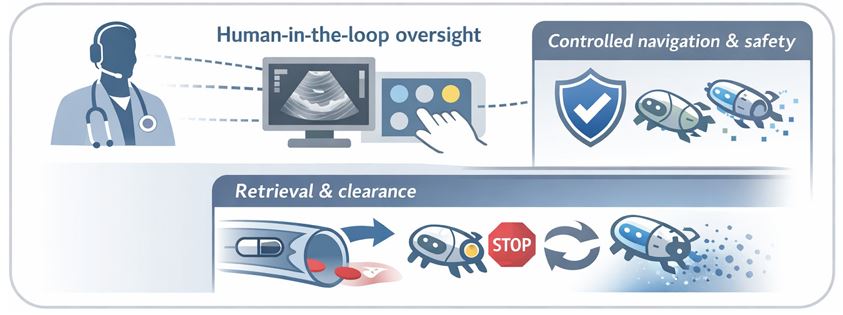
A further benefit for its application in theranostics could be its integrated functionality of sensing, imaging, and therapy. The microrobot guided by ultrasound for imaging shows how treatment can be confirmed in real-time rather than merely through the pharmacodynamic effect (Figure 1) [7,8]. This is very much in line with the emphasis on personalized therapy, in which the differences between individuals could possibly be a result of variation in targets rather than identity itself.
Medical molecular robotics also enables functional adapt ability. Soft and reconfigurable microrobots can alter shape or mechanical properties in response to environmental cues, improving navigation through heterogeneous biological media such as mucus, branching vasculature, or interstitial tissue [9]. At the molecular scale, programmable nanostructures such as DNA origami offer the possibility of encoding logical rules for multivalent targeting and conditional payload release, allowing therapeutic activity to be matched to patient-specific molecular signatures [10]. Collectively, these features suggest a future in which personalization is achieved not only through drug selec tion but through controllable delivery dynamics.
Limitations and translational challenges
Although very promising, there are many translational chal lenges to the application of medical molecular robotics. The re liable navigation and control in a biological tissue are hard to master with regard to biological dynamics of tissue hydration [4]. The high-resolution tracking in a safe way for long interven t ions would also a be hard task to master [8].
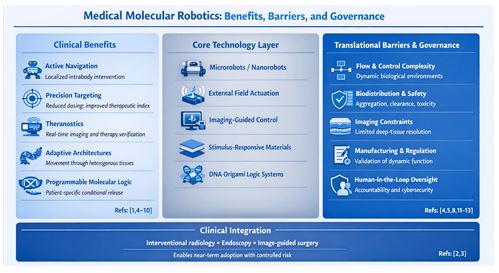
Biocompatibility issues also introduce new restrictions. The potential for the microdevice poses challenges that are quite different from pharmacotherapy, such as mechanical obstruc t ion, unintentional aggregation, vascular occlusion, and unpre dictable biodistribution patterns. The ability of microrobots to navigate the sensitive area of the brain's vasculature demon strates the potential for therapy as well as the need for strict control over the device's behavior, reversibility, and predeter mined safety levels [11]. The device's clearance or bioresorp t ion needs to be reliable for regulatory requirements to be met. From regulatory and manufacturing perspectives, molecular robotic systems challenge existing frameworks because their function depends on dynamic behavior rather than material composition alone. Scalable fabrication, rigorous quality con trol, and validation of performance metrics will be essential prerequisites for widespread clinical adoption [1,5].
Ethical, operational, and governance considerations
As with macroscopic robotic surgery and telemedicine, in creasing autonomy and connectivity raise ethical and gover nance concerns (Figure 1). These issues are amplified in medical molecular robotics, where decision-making may involve algo rithmic navigation, remote actuation, and real-time intrabody data integration. Human-in-the-loop oversight is therefore critical—particularly in early clinical deployment—to ensure accountability, traceability, and rapid intervention in the event of device malfunction or unexpected physiological responses [12,13]. Operationally, the most plausible near-term applica t ions are those that integrate seamlessly into established pro cedural ecosystems, such as interventional radiology or endos copy, where imaging, access routes, and emergency protocols are already defined—mirroring the historical adoption trajec tory of robotic surgery [2,3].
Medical molecular robotics represents a natural and po tentially transformative extension of precision medicine and robot-assisted therapies. Its defining advantages—localized drug delivery, integrated theranostics, and adaptive function ality—address long-standing limitations of systemic treatments and passive targeting strategies (Figure 1). Nevertheless, the f ield faces substantial challenges related to safety, controlla bility, visualization, manufacturability, and regulation. If these constraints are addressed systematically, medical molecular ro botics may progress from experimental innovation to a clinically meaningful adjunct, enhancing personalization, efficacy, and safety across multiple medical disciplines.
Acknowledgment: ChatGPT 5.2 refine the report and generate the figure