Department of Psychiatry, First Faculty of Medicine, Charles University and General University Hospital in Prague, Ke
Karlovu 11, 120 00 Prague, Czech Republic.
Distinguished Teaching Professor Emeritus, Distinguished Academy, State University of New York, USA.
*Corresponding author: George B Stefano
Distinguished Teaching Professor Emeritus, Distinguished Academy, State University of New York, USA.
Email: gstefano@sunynri.org
Received: Oct 15, 2025
Accepted: Nov 10, 2025
Published Online: Nov 17, 2025
Journal: Journal of Artificial Intelligence & Robotics
Copyright: © Stefano GB (2025). This Article is distributed under the terms of Creative Commons Attribution 4.0 International License.
Citation: Stefano GB. How quantum computing could rewire medical robotics. J Artif Intell Robot. 2025; 2(2): 1031.
Quantum computing may be a force multiplier for medical robotics by speeding motion planning, kinematics, and multi-robot coordination; advancing perception using quantum-enabled imaging; and delivering personalized, data-intensive control policies. Near term, hybrid quantum-classical methods will perhaps achieve moderate but discernible reductions in latency and accuracy, particularly for constrained sub-problems. But current hardware remains small scale and noisy, comparative empirical advantage is negligible, and risks for safety, validation, and governance is real. A thoughtful course is “human-in-the-loop” hybridization—implementing quantum sub-routines in classical pipelines and physician supervision such that acceleration or sensitivity advantages yield credible, clinically impactful benefit.
Medical robotics is evolving from rigid automation towards flexibility, patient-customized help, and real-time feedback. Quantum Computing (QC), while not necessarily supplanting classical control, may have a catalytic role by speeding-up the most challenging computational kernels—notably when robots are required to search for things, coordinate efforts, or optimize under constraints. Anchoring this in a clinical–human context: models of care like the BERN framework (Behavior, Exercise, Relaxation, Nutrition) underscore that technology augmentation must lighten the burden to the clinician and improve patient well-being; QC-enhanced robotics by the same token must be held accountable for that—not benchmark improvements alone (Figure1) [1].
An interesting early exploitation area is motion control and trajectory planning. For instance, the inverse kinematics problem of multi-joint manipulator arms is combinatorically explosively difficult. In “Quantum computation for robot posture optimization,” Otani and coauthors (2025) represent each robot’s link posture by a qubit so that the forward kinematics corresponds to a quantum circuit, while the inverse kinematics are solved by classical iterative optimization [2]. They showed that the two-qubit rotation gates are able to represent root and tip joint dependencies such that convergence may be sped-up for posture control tasks. Most importantly, they proved the result valid for real IBM quantum hardware by achieving a reduction of the error by a maximum of 43% relative to classical solvers for a virtual 17-joint robot arm. This is one of the very first concrete implementations of the quantum methods solving a whole robotic optimization task with measurable quality gain.
Such hybrid methods may eventually be applied to surgical robot subsystems (e.g., locked-arm motion around anatomy or instrument path optimization) where latency and accuracy are paramount. They show how QC need not appear as a blanket control system but rather as a kernel accelerator tucked inside traditional robotic structures. Perception, sensor fusion, and image-based guidance is a second promising area. Although quantum algorithms for real-time live imaging are in their initial stages of development, quantum-enhanced sensing—notably Nitrogen-Vacancy (NV) diamond magnetometry and quantum photonics—has already been pushed to sub-millimetric accuracy in the measurement of magnetic-field and thermal distributions [3]. Such technologies may eventually complement robotic navigation or neurostimulation guidance.
Beyond the university context, Stefano (2024) contending that QC will expedite biomolecular simulation and imaging analysis pertinent to neurodegeneration naturally extending to robotic systems that incorporate neuro-sensing or molecular diagnostic information [4]. It is surmised that further details how quantum computation and artificial intelligence in tandem might redefine surgical robotics by integrating adaptive learning in quantum-accelerated control mechanisms later repositioning the role of the surgeon from operator to that of supervisory interpreter [5].
Complementary robotics research, for example, Nigatu et al. (2025), applies Grover’s algorithm to improve search in the robotic configuration space and demonstrates orders-of-magnitude computational scaling in simulated multi-arm situations [6]. Likewise, recent surveys emphasize QC’s applicability to combinatorial schedules and motion-planning challenges where quantum annealing or variational hybrid algorithms are able to significantly shorten solution times [7].
However, several caveats remain:
1. Hardware limitations– We are yet in the early Noisy-Intermediate-Scale Quantum (NISQ) era. Fault-tolerant quantum processors for running large scales in real time for robotics are years ahead.
2. Benchmarking and empirical evidence – Most claimed quantum advantages are shown using scaled-down models under idealized conditions; strengthening head-to-head testing in biomedical robotics is unavailable.
3. Validation and standards – Medical devices instrumenting QC will need to have reproducible, auditable constructs and understandable integration with clinical quality systems.
4. Safety and governance – Quantum modules introduce obscurability and cybersecurity risk; the systems need to have human-override function and fall back to deterministic control.
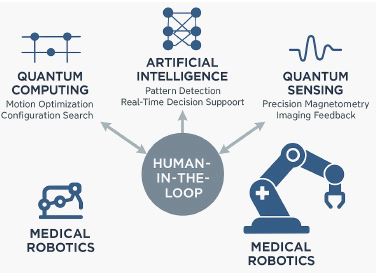
Taken together, the most prudent course is hybrid integration: implement quantum acceleration in tight, tightly framed kernels (e.g., inverse kinematics or optimization subroutines), framed by traditional deterministic logic. This hybrid model is consistent with “human-in-the-loop” clinical governance, transparency and safety being ensured while measurable benefit is possible. If that balance is struck, quantum-boosted medical robotics may move from fantasy to clinical fact in the decade ahead—bringing quicker adaptation, smoother motion and smarter response without loss of trust.
Acknowledgments: Figure was generated by ChatGPT 5.o.