1Université Grenoble Alpes, AGEIS, 621 Av. Centrale, 38000 Saint-Martin-d’Hères, France.
2Université Lumière Lyon 2, Institut des Sciences et Pratiques d’Éducation et de Formation (ISPEF), Laboratoire Éducation, Cultures & Politiques (EA 4571), 4bis Rue de l’Université, 69007 Lyon, France.
*Corresponding author: Mustapha Rachdi
Université Grenoble Alpes, AGEIS, 621 Av. Centrale, 38000
Saint-Martin-d’Hères, France.
Email: mustapha.rachdi@univ-grenoble-alpes.fr
Received: Jun 21, 2025
Accepted: Jul 21, 2025
Published Online: Jul 28, 2025
Journal: Journal of Artificial Intelligence & Robotics
Copyright: © Rachdi M (2025). This Article is distributed under the terms of Creative Commons Attribution 4.0 International License.
Citation: Fernex A, Filippi L, Maghraoui M, Rachdi M. Towards intelligent time management applications for students: A technical framework for data collection, modeling, and personalized feedback. J Artif Intell Robot. 2025; 2(2): 1024.
This article presents a comprehensive architecture for a mobile application, STUR (Student Time Use and Regulation), designed to enhance students’ time management. Merging learning analytics, highdimensional statistics, and mobile computing, our framework supports students through data-driven recommendations and personalized feedback. We detail the system’s components, from multimodal data collection and preprocessing to AI-based categorization and feedback generation. The architecture also integrates a conversational interface to promote metacognitive regulation. The article concludes with perspectives on integrating federated learning and explainable AI for future developments.
Time is a fundamental resource for students, profoundly influencing not only their academic success but also their psychological well-being and personal development [1]. In today’s educational landscape, characterized by increasing adoption of hybrid, asynchronous, and autonomous learning modalities, effective time management has become a major challenge. Students are required to plan, monitor, and regulate their daily activities with greater sophistication. However, traditional time management tools—such as paper planners or generic digital calendars—are often inadequate for addressing the complex schedules and motivational and cognitive factors involved [5,6].
Recent advances in machine learning and high-dimensional statistics offer promising avenues for finely modeling students’ temporal behaviors and delivering adaptive, personalized feedback [3,8]. In particular, Functional Data Analysis (FDA) and clustering techniques provide robust frameworks to analyze continuous time-series data representative of daily activities [2,4]. It is within this context that the STUR (Student Time Use and Regulation) mobile application was developed to meet the intricate time management needs of students by capturing and analyzing a broad range of daily activities.
STUR is the result of a research project funded by the French National Research Agency (ANR) and carried out through a collaboration between the University Grenoble Alpes and University Lyon 2. This interdisciplinary partnership brings together expertise in educational sciences, statistics, and artificial intelligence to design an innovative tool supporting students’ temporal self-regulation.
The application covers multiple essential activity categories to understand students’ life rhythms: sleep, which is foundational for cognitive and emotional well-being, focusing on quality, duration, and regularity of sleep cycles [1]; academic work, encompassing lectures, studying, reading, and exam preparation, which constitutes the core of students’ commitments; physical exercise, recognized for its role in stress regulation and executive function improvement; paid employment, which often adds temporal constraints but also opportunities for learning and autonomy; social life, including family, friends, and associative interactions, vital for emotional balance; internet usage and digital resource engagement, influencing both productivity and distraction; and self-reported academic results, which associate temporal behaviors with subjective performance evaluation and perceptions.
The application also addresses the common reality of multitasking in students’ daily lives, where multiple tasks may occur simultaneously or overlap. Using machine learning models and advanced temporal segmentation techniques based on functional clustering and regression [2,4], STUR can detect and precisely model such overlaps, offering a dynamic and nuanced representation of time use. This capability is critical for understanding cognitive dispersion and the impact of task switching on productivity and motivation [7].
Personalized feedback provided to users is based on a multidimensional analysis of collected data, combining statistical methods such as clustering and principal component analysis with supervised predictive models. Feedback includes diagnostics on task fragmentation, imbalances between activity domains, and well-being indicators such as sleep quality. Based on this, STUR offers concrete, tailored recommendations aimed at fostering better structuring of academic work periods to reduce cognitive dispersion, encouraging regular sleep and recovery routines, integrating active breaks through sports or social interactions to enhance stress resilience, optimizing digital tool usage to improve focus, and adjusting paid workloads in line with individual capacities and goals.
These recommendations are delivered interactively via an integrated chatbot, developed through extensive preparation of artificial intelligence modules and Natural Language Processing (NLP). This conversational system relies on supervised and unsupervised learning algorithms capable of understanding user intents, detecting emotions, and providing contextualized dialogue. Machine learning models continuously adapt responses according to user profiles and history, promoting active metacognition and conscious time regulation [7]. The chatbot design leverages open-source frameworks like Rasa, with a modular architecture ensuring scalability, privacy, and advanced personalization.
Collecting and processing sensitive data, especially healthrelated information such as sleep or perceived stress, raise significant regulatory and ethical challenges. STUR strictly complies with the General Data Protection Regulation (GDPR), ensuring explicit and renewable consent, data anonymization and security, and full transparency about data usage [4]. Protocols include fine-grained consent management, allowing users to precisely choose which data categories to share. Furthermore, the technical architecture incorporates end-to-end encryption and favors local data processing when feasible—especially through federated learning—to minimize risks related to centralizing personal data [9].
By combining functional richness with strong privacy guarantees, STUR aims to build a trust relationship with students, a sine qua non for the adoption and sustained use of such a time management support tool. In sum, STUR positions itself as an innovative device grounded in an interdisciplinary approach merging educational sciences [1,6], advanced statistics, and artificial intelligence, designed to assist students in constructing a mastered and reflective temporality. This system paves the way for a new generation of intelligent pedagogical tools that integrate adaptive feedback based on empirical data and account for the complexity and plurality of student temporalities.
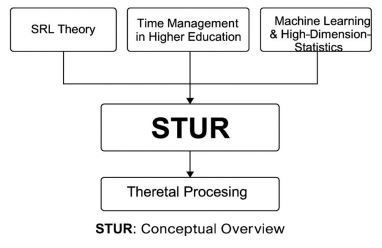
The STUR system architecture is conceptualized as a modular, scalable framework designed to capture, process, and analyze heterogeneous data streams emanating from students’ daily activities. Its core components include:
Data collection
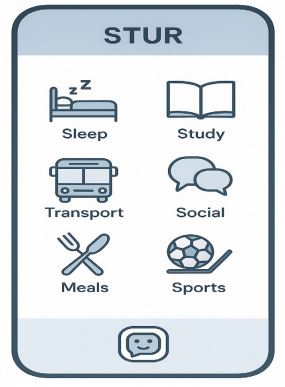
Multimodal data acquisition integrates smartphone sensor inputs (e.g., accelerometer, GPS), application usage logs, and self-report surveys. Importantly, data entry is facilitated through both manual inputs and an AI-powered conversational chatbot, enabling intuitive and flexible task logging. The application tracks a rich taxonomy of activities including sleep, academic work, sport, paid employment, social life, internet use, and declarative academic results (e.g., self-reported grades). It explicitly accounts for parallel or overlapping tasks to capture multitasking phenomena, reflecting the complexity of realworld student time use.
Preprocessing and normalization
Raw data streams are synchronized temporally, cleaned to remove noise and artifacts, and transformed into a unified, time-indexed functional data format. Functional Principal Component Analysis (FPCA) and related FDA techniques are employed to reduce dimensionality while preserving essential temporal patterns, facilitating efficient downstream modeling.
Categorization and modeling
Supervised machine learning algorithms, including Support Vector Machines and Random Forest classifiers, categorize time segments into predefined activity classes using labeled data derived from the pilot study. Complementarily, unsupervised clustering methods such as k-means and DBSCAN identify behavioral profiles, supporting personalized feedback generation. These models are designed for iterative retraining to adapt continuously to evolving user data.
Feedback generation
Personalized, actionable feedback is delivered through an interactive dashboard and a conversational AI chatbot powered by the Rasa framework. The system offers recommendations tailored to individual behavior patterns—for example, advising on reducing task fragmentation, increasing sleep duration, or balancing social and academic commitments—to promote metacognitive regulation and well-being.
Implementation employs React Native for cross-platform mobile application development, a Python backend utilizing scikit-learn and TensorFlow for machine learning workflows, and PostgreSQL for secure data storage. The architecture ensures compliance with GDPR through end-to-end encryption, OAuth2-based authentication, and anonymized user identifiers. Given the inclusion of sensitive health-related data (e.g., sleep patterns), the system incorporates stringent consent management processes aligned with ethical guidelines and legal requirements, adding layers of complexity to data governance and user privacy.
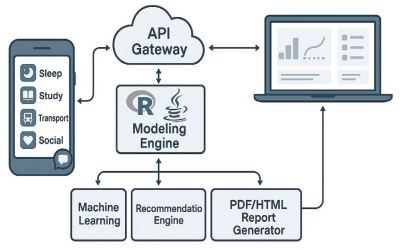
To ensure efficient processing of students’ time-use data, the STUR system is built on a modular and scalable architecture. Figure 4 illustrates the complete set of system components, from mobile data collection to personalized feedback through an interactive dashboard.
As shown in Figure 4, data are first collected by the mobile application, then transmitted to the backend server for storage. The data are subsequently processed through modules for clustering and classification. Finally, a recommendation engine generates personalized feedback delivered to the end user via the mobile interface or dashboard.
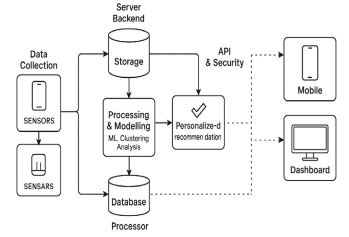
Figure 4 illustrates the modular architecture of the STUR system. Data collection begins with sensors integrated in mobile devices, capturing students’ time-use activities. These data flow into the server backend, where they are stored securely and processed through machine learning modules performing clustering and analysis. The processed information is saved in a database and used by a recommendation engine to generate personalized feedback. This feedback is then delivered back to the users via secure APIs, accessible through both a mobile application and an interactive dashboard. The architecture ensures scalability, security, and real-time personalized insights for effective time management.
To empirically validate STUR, an eight-week pilot study was conducted with 700 university students recruited from the University of Grenoble and Lyon 2 University, as part of a collaborative research project funded by the French National Research Agency (ANR). Participation required informed consent under protocols approved by institutional ethics review boards.
The multimodal data acquisition strategy combined:
• Weekly self-report surveys measuring perceived stress (via the Perceived Stress Scale- 4; Cohen et al., 1983), time satisfaction, and subjective academic performance.
• Passive logging of smartphone sensor data and application usage metrics.
Conversational logs capturing interactions with the AI chatbot used for task entry and motivational support.
The preprocessing pipeline harmonized heterogeneous data into a comprehensive time-indexed dataset reflecting multiple concurrent tasks. Supervised ML models were trained on a labeled subset of the data, achieving average classification F1- scores exceeding 0.85. Unsupervised clustering revealed distinct behavioral phenotypes across participants.
Data privacy was rigorously maintained through anonymization and secure storage in EU- compliant cloud infrastructure. Participants retained full rights to withdraw and delete their data at any time.
| Variable | Description | Values/Range |
|---|---|---|
| Number of participants | Total number of student participants in the pilotstudy | 700 |
| Universities involved | Partner institutions participating in the pilot | University of Grenoble, University of Lyon 2 |
| Study duration | Length of the pilot studyperiod | 8 weeks |
| Age range | Participant age distribution | 18–29 years |
| Data types collected | Types of data acquired duringthe study | Self-report, sensordata, app usage,chatbot logs |
| Self-reported measures | Weekly questionnaires on stress, timesatisfaction, performance | PSS-4, customsurveys |
| Sensor data | Passive smartphone datacollected | GPS, accelerometer, screen time |
| Chatbot interactions | Logs of conversational input for tasksand reflections | Textual entries, timestamps |
| Multitasking captured | Parallel task tracking capability | Yes |
| Privacy protocols | Data governance and ethical compliance | Anonymized IDs,GDPR-compliant |
Preliminary results
Analysis revealed three primary behavioral clusters:
• Stable planners: Students with consistent daily routines, exhibiting strong alignment between planned and actual activities.
• Chaotic responders: Participants with fragmented schedules, frequent task-switching, and lower self-reported time satisfaction.
• Fragmented users: Individuals demonstrating erratic time use, high multitasking, and elevated stress levels.
Quantitative results indicated a 23% improvement in congruence between planned and actual task execution post-intervention. Perceived Stress Scale scores decreased by approximately 15%, reflecting potential psychological benefits. User experience feedback showed 82% of participants found the system’s visualizations and personalized recommendations helpful for enhancing self-regulation.
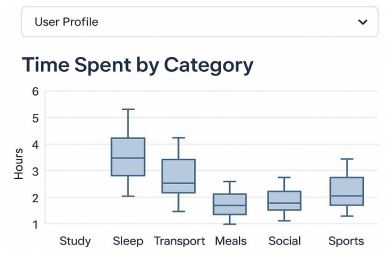
Figure 5 is for an individual profile. We can therefore provide feedback and some recommendations for this individual. For this individual, the recommendations might be: “You spend a lot of time studying, while you spend little time exercising. Consider balancing your schedule by incorporating more physical activity into your routine.”
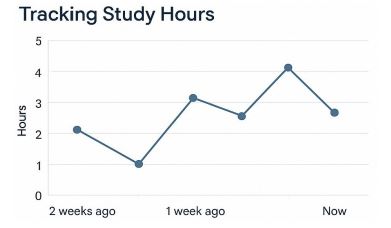
The line graph, in Figure 6, gives another individual recommendation for the same individual. It indicates: “the fluctuation in your daily study hours over the past 3 weeks. It appears that your study time has been inconsistent during this period”.
The STUR conversational agent employs advanced natural language processing techniques to engage students in reflective dialogues regarding their time management. Intent detection and sentiment analysis underpin adaptive responses, enabling tailored prompts that encourage metacognitive reflection— such as reconsidering task prioritization or suggesting mindfulness breaks when elevated stress is detected.
Future development will integrate:
• Reinforcement learning to dynamically optimize recommendation strategies based on user responses.
• Temporal knowledge graphs to contextualize time use within broader activity and emotional patterns.
• Transformer-based NLP models to facilitate more naturalistic, emotionally intelligent conversations.
• Federated learning architectures to maintain privacy while aggregating decentralized data for model improvements.
These innovations aim to deliver an ethical, explainable AI companion fostering sustainable behavioral change.
Functional specifications and data privacy
STUR supports comprehensive logging of diverse task categories—sleep, academic work, sport, employment, social activities, internet use, and declarative academic outcomes—with explicit capture of parallel tasks. Feedback is personalized based on behavioral clusters and individual profiles.
The technology stack includes React Native (frontend), Python FastAPI (backend), PostgreSQL (database), and ML frameworks (scikit-learn, TensorFlow). The system supports real-time synchronization and offline operation.
Robust privacy measures include:
• End-to-end encryption for all communications.
• OAuth2 authentication paired with anonymized user IDs.
• Strict compliance with GDPR and specific regulations concerning health data.
• Detailed informed consent processes to address the sensitivity of health-related data, such as sleep metrics.
These protocols ensure legal compliance and foster user trust.
| Variable | Description | Values/Range |
|---|---|---|
| Number of participants | Total number of student participants in the pilotstudy | 700 |
| Universities involved | Partner institutions participating in the pilot | University of Grenoble, University of Lyon 2 |
| Study duration | Length of the pilot studyperiod | 8 weeks |
| Age range | Participant age distribution | 18–29 years |
| Data types collected | Types of data acquired duringthe study | Self-report, sensordata, app usage,chatbot logs |
| Self-reported measures | Weekly questionnaires on stress, timesatisfaction, performance | PSS-4, customsurveys |
| Sensor data | Passive smartphone datacollected | GPS, accelerometer, screen time |
| Chatbot interactions | Logs of conversational input for tasksand reflections | Textual entries, timestamps |
| Multitasking captured | Parallel task tracking capability | Yes |
| Privacy protocols | Data governance and ethical compliance | Anonymized IDs,GDPR-compliant |
While the pilot demonstrates STUR’s feasibility and potential impact, several limitations remain. Sampling bias is possible due to voluntary participation and reliance on self-reported data. The accurate modeling of multitasking and task-switching presents methodological challenges that may underestimate cognitive load. Sustained user engagement beyond pilot phases needs investigation; integrating gamification and social support features may help address attrition.
Ethical concerns around AI transparency, user autonomy, and data privacy necessitate ongoing attention to ensure recommendations empower rather than constrain users. Iterative, participatory design involving diverse stakeholders is recommended to refine system robustness and relevance.
In conclusion, we have presented STUR, a data-centric system for time management grounded in pedagogical theory and statistical innovation. The development journey from pilot study to product implementation illustrates a robust pipeline that embodies interdisciplinary convergence between education sciences, machine learning, and human-computer interaction.
Looking forward, our next priorities include conducting longitudinal impact assessments to evaluate STUR’s effectiveness over extended periods, integrating the application within broader digital campus ecosystems to enhance accessibility and scalability, and refining AI- driven feedback mechanisms through hybrid reinforcement learning and graph-based models. Moreover, we emphasize the importance of participatory design approaches to ensure an inclusive user experience that meets diverse student needs. Finally, continued socio-educational research focusing on students’ temporal narratives will deepen our understanding of time management practices and inform future system enhancements.