
1Creative Computing Institute, University of the Arts London, United Kingdom.
2Faculty of Law, Kazan (Volga region) Federal University, Russia.
3Faculty of Control Systems and Robotics, National Research University for Information Technology, Mechanics and Optics (ITMO), Russia.
*Corresponding author : Chun Hong Yuan
Faculty of Control Systems and Robotics, National Research University for Information Technology, Mechanics and Optics (ITMO), St. Petersburg, 197101, Russia.
Email: ChYuan@stud.kpfu.ru
Received: Mar 25, 2025
Accepted: Apr 22, 2025
Published Online: Apr 29, 2025
Journal: Journal of Artificial Intelligence & Robotics
Copyright: © Yuan CH (2024). This Article is distributed under the terms of Creative Commons Attribution 4.0 International License.
Citation: Fu QY, Dong SH, Yuan CH. The current status and challenges of artificial intelligence in the digital preservation of cultural heritage. J Artif Intell Robot. 2025; 2(1): 1018.
Artificial Intelligence (AI) technologies are increasingly being applied in the field of digital preservation of cultural heritage, offering new approaches for the documentation, restoration, management, and dissemination of cultural artifacts. This paper presents a global overview of the latest research progress on the use of AI in heritage preservation, with a focus on the application of computer vision, deep learning, graph neural networks, and natural language processing in areas such as 3D reconstruction, image restoration, object recognition, semantic annotation, and cross-modal analysis. By analyzing representative studies in recent years, the paper reveals the achievements and limitations of AI technologies in real-world cases including church mural restoration, 3D scanning of artifacts, and the digitization of ancient books. It also compares key features of representative projects such as the CHER-Ob platform, Google Arts & Culture, and CyArk. The paper summarizes AI’s contributions to the digital preservation of cultural heritage—including accelerating the digitization process, enhancing analytical precision, and enriching public engagement—while identifying critical challenges such as data scarcity, limited model generalization, and ethical and authenticity concerns. Finally, it outlines future research directions, such as building open multimodal heritage datasets, developing interpretable heritage AI models, strengthening human-AI collaboration, and formulating ethical norms for digital heritage, with the aim of providing technological guidance for sustainable cultural heritage preservation.
Keywords: Artificial intelligence; Cultural heritage preservation; Digitization; 3D Reconstruction; Image restoration; Semantic annotation; Cross-modal analysis.
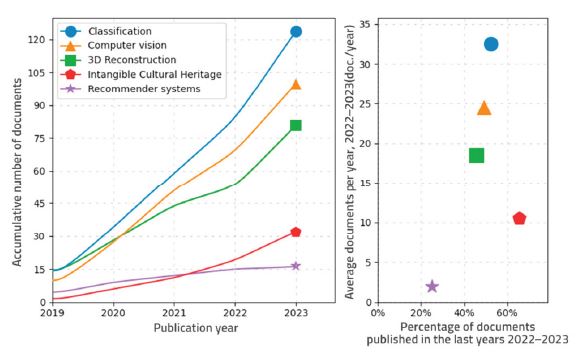
Cultural heritage is a valuable asset of human civilization, and its protection and transmission carry great significance. However, many precious heritage sites and artifacts are under threat from natural and human factors. Traditional preservation methods struggle to meet the growing demand for large-scale and diverse forms of heritage digitization. In recent years, the integration of digital technologies—particularly artificial intelligence—has brought new opportunities for cultural heritage preservation. Global studies show a rapid increase in publications related to AI applications in the heritage field since 2019. As shown in Figure 1, the number of publications across various topics continues to rise, reflecting the growing academic interest in this interdisciplinary domain. The main application hotspots of AI in heritage preservation include classification and computer vision techniques, 3D reconstruction, recommendation systems, and the digitization of intangible cultural heritage [1].
ous topics continues to rise, reflecting the growing academic interest in this interdisciplinary domain. The main application hotspots of AI in heritage preservation include classification and computer vision techniques, 3D reconstruction, recommendation systems, and the digitization of intangible cultural heritage [1].
In addition, new explorations of AI in the cultural heritage field include enhancing digital image restoration with deep learning, automatically extracting choreographic sequences from traditional dance footage, improving digital accessibility and recommendation systems in museum collections, and supporting digital management and content analysis of archival documents. For instance, Liu’s research [4] reviewed the progress of image restoration algorithms applied to artwork recovery; Rallis et al. [5] evaluated machine learning techniques in traditional dance motion capture and analysis; and Colavizza et al. [6] discussed frontier topics concerning AI in digital archival management. Together, these studies demonstrate that AI technologies are increasingly integrated into all aspects of cultural heritage preservation, showing great potential for enhancing preservation outcomes.
Despite significant progress, the application of artificial intelligence in cultural heritage preservation still faces numerous challenges and unresolved issues, requiring further in-depth investigation. The purpose of this paper is to systematically review the latest research developments in this field, summarize methods and practical experiences of AI in the digital preservation of various types of cultural heritage, and analyze existing limitations and challenges.
The structure of this paper is arranged as follows: the introduction section outlines the importance of digital preservation of cultural heritage and the background and trends of AI involvement; the methodology section reviews the core techniques and recent studies on AI applications in 3D reconstruction, image restoration, object recognition, semantic annotation, and cross-modal learning, categorized by technology type; the experimental and case analysis section focuses on evaluating the application outcomes of different AI technologies in real-world cultural heritage preservation projects, including comparative tables and global case studies; the conclusion summarizes AI’s contributions to digital heritage preservation, identifies current issues, and looks ahead to future research directions.
3D reconstruction and digital modeling
3D reconstruction is one of the fundamental steps in the digitization of cultural heritage, aiming to accurately recreate artifacts or heritage sites in the form of digital 3D models. Traditional methods mainly rely on techniques such as laser scanning, structured light, and photogrammetry. For instance, institutions like CyArk acquire high-precision point cloud data through terrestrial laser scanning and aerial imagery, which are then used to generate textured mesh models. In recent years, artificial intelligence technologies have been introduced into the 3D reconstruction process to improve automation and reconstruction quality. Deep learning, for example, can be used for automatic registration, denoising, and classification of point cloud data, transforming massive scanning data into structured 3D models [10]. Generative models such as Neural Radiance Fields (NeRF) learn implicit representations of scenes from multi-view images, enabling the rendering of highly detailed 3D models of artifacts. These models are particularly effective in reconstructing heritage objects with complex geometry or textures. A study by Croce et al. [3] reviewed the potential applications of NeRF in the field of digital heritage and noted that NeRF can generate high-fidelity virtual reconstruction models in scenarios where traditional photogrammetry struggles [3]. Other studies have used deep neural networks to automatically reconstruct the 3D shapes of fragmented artifacts; for example, Ostertag et al. [23] modeled the reassembly of fragments as a “jigsaw puzzle” task, employing graph neural networks to predict adjacency based on the edge features of the fragments, thereby automatically piecing together and restoring ancient documents. Overall, AI-driven 3D reconstruction is improving efficiency and intelligence across all stages—from data acquisition and point cloud processing to model generation—allowing for the rapid and large-scale production of high-precision digital heritage models, which provides a foundation for subsequent research and virtual exhibition.
Image restoration and virtual repair
Many forms of cultural heritage—such as paintings, rubbings, and murals—are preserved in two-dimensional image formats, and often suffer from fading, peeling, or damage over time. The application of artificial intelligence in digital image restoration offers a powerful tool for the virtual restoration and faithful reproduction of these artifacts. Traditional digital restoration relies on manual retouching and interpolation, whereas the emergence of deep learning, especially Generative Adversarial Networks (GANs), has made automated image restoration possible. Kumar and Gupta proposed a GAN framework based on residual networks to restore damaged artwork images, achieving digital reconstruction of mottled or cracked areas. These models learn from large datasets of intact and damaged images to automatically fill in missing details and reconstruct textures and patterns, thus digitally “repairing” damaged murals or calligraphy. Comparative evaluations of different image restoration models on artworks have shown that deep convolutional networks, Transformers, and other models have their respective strengths in restoration accuracy and visual coherence, with multi-scale feature fusion models often performing best. Notably, virtual image restoration can serve not only for digital display but also as a tool for physical restoration—by simulating different restoration scenarios, it assists conservators in evaluating options before actual intervention. Current challenges include the models’ dependence on training data and their limited understanding of artistic styles. To address this, some studies have introduced transfer learning and style constraints, enabling models to maintain consistency with specific historical art styles even with limited samples, thereby improving the authenticity and scholarly value of restoration outcomes.
Object detection and recognition
Object detection and pattern recognition technologies have broad applications in the digitization of cultural heritage, including automatic classification of artifact images, identification and localization of architectural elements, and detection of damage and deterioration. In artifact image classification, researchers have developed numerous deep learning-based models to recognize different types of cultural objects and their attributes. For example, Navarro et al. [10] trained convolutional neural networks to automatically extract image features of Iberian pottery fragments unearthed during archaeological excavations, achieving automatic classification of decorative patterns and shapes, thus offering an efficient tool for archaeological typology. Similarly, Barucci et al. [9] used deep convolutional networks to classify ancient Egyptian hieroglyphs, significantly enhancing the automatic interpretation of large-scale epigraphic images. In the field of architectural heritage, Obeso et al. [11] combined saliency extraction with CNNs to classify architectural styles from building imagery, enabling automatic identification of historical periods and stylistic features, and supporting typological studies of architectural heritage. Object detection technologies are also used for damage assessment and preservation status monitoring. Some studies have applied deep detection models such as YOLO to automatically identify cracks, peeling, and other damage on historic building facades. Research by Lee and Yu demonstrated that deep learning-based surface damage classification achieved high accuracy in identifying the degree of weathering on ancient buildings, allowing for timely identification of conservation risks. Additionally, object recognition from 3D scan data is a growing area of interest: some algorithms combine 2D imagery with 3D point clouds to autoautomatically locate sculptures, inscriptions, and other elements in complex archaeological sites. Pathak et al. [16] proposed a detection method that fuses UAV imagery with terrestrial point clouds to identify structural damage in heritage sites, demonstrating the advantage of combining 2D and 3D data. Overall, AI-driven object recognition technologies greatly enhance the automatic interpretation of digital heritage data, reducing manual annotation workloads and laying the foundation for large-scale heritage studies, such as cross-site comparative analysis.
Semantic annotation and knowledge association
Semantic annotation refers to the content-based tagging and linking of digital cultural heritage resources to facilitate better information management and utilization. Traditionally, this task depends on manual annotation by experts, but the introduction of artificial intelligence enables large-scale semantic labeling. At the image level, researchers use deep learning models to perform semantic segmentation and annotation of heritage images, automatically classifying elements such as figures, scenes, and decorative patterns. For example, in a project involving high-resolution images of museum collections, models were trained to automatically identify characters and associated mythological themes depicted in paintings, generating semantic tags for each artwork to support subsequent retrieval and research. Beyond visual content, knowledge graphs and graph neural networks have begun to be used for knowledge association and reasoning in cultural heritage. By constructing knowledge graphs that include heritage entities (such as people, events, places, and artifacts) and their relationships, AI can assist in uncovering hidden historical connections and contexts. Some systems link museum objects to historical documents and genealogical data, using graph algorithms to discover cross-collection associations and reveal the historical networks behind artifacts. Furthermore, research by Oetterli et al. [23] explored using graph neural networks to reconstruct fragmented documents, which is essentially a form of knowledge association: fragments are treated as nodes, and the AI infers their relationships (e.g., adjacency or sequence) based on textual coherence and physical edge matching, thereby restoring the original document. This demonstrates the unique advantages of graph neural networks in handling fragmented heritage knowledge. In general, semantic annotation and knowledge association technologies help transform digital cultural heritage from mere “data” into “knowledge.” By automating annotations and building semantic links, heritage databases become more searchable and interpretable, enabling researchers and the public to more easily uncover connections among heritage elements and form systematic understandings of the past.
Cross-modal learning and multimodal integration
Cultural heritage information is often multimodal, encompassing images, text, audio, and 3D models. Cross-modal learning aims to integrate data from different modalities to enable more comprehensive analysis and applications. For instance, in museum digitization, researchers seek to realize functions such as “image-to-artifact” or “text-to-image” searches, allowing users to retrieve heritage images through descriptive text or find related records based on visual input. These functions can be achieved by jointly learning cross-modal embedding spaces, where visual and semantic features are projected into a shared vector space for direct comparison. Castellano et al. [15] proposed a visual link retrieval framework that combines computer vision with knowledge graphs in a painting dataset, enabling automatic retrieval of thematically or stylistically related works, thus assisting art historians in uncovering latent connections. In archaeology, cross-modal methods have been used to align spatial imagery of sites with historical descriptions, such as using deep learning to detect features in satellite images of archaeological sites and then linking them to textual records through geographic coordinates, thus integrating remote sensing discoveries with archaeological knowledge. Some studies have also explored the use of image captioning in heritage contexts, training models to automatically generate descriptive text for images of artifacts. This technology can support automated annotation of artifacts from different eras and even provide spoken descriptions of artworks for visually impaired users, enhancing inclusive access to heritage. It is worth noting that the digitization of intangible cultural heritage also involves multimodal integration—for example, combining motion capture data of dance with oral lyrics and music, or analyzing the audiovisual correspondence in traditional opera recordings. Chen et al. [14] used a cognitive network model to integrate acoustic features and lyrics content, achieving automatic classification of Cantonese opera singing styles, showing the value of cross-modal learning in intangible heritage studies. By fusing data from multiple sources, AI can gain deeper insights into cultural heritage than single-modality approaches, offering more intelligent services such as smart tours and virtual storytelling, and enriching the public’s digital cultural experience.
| Technical method | Application field | Representative studies (Citation) |
|---|---|---|
| 3D Reconstruction | Digital modeling of artifacts and heritage sites | NeRF for high-precision modeling in heritage scenes [3]; Pointcloud segmentation forstructural deformation [10] |
| Image Restoration | Digital restoration of paintings and murals | GAN-based restoration of damaged artwork images [15]; Convolutional networks for muralinpainting [4] |
| Object Recognition | Artifact classification, damagedetection | Deep learning classification of pottery fragments [10]; YOLOdetection of architectural damage |
| Semantic Annotation | Image content tagging, document reassembly | CNN identification of architectural style elements; GNN-based document fragment reconstruction [23] |
| Cross-modal Learning | Multimodal retrieval, intangible heritage analysis | Visual-text retrieval of similar paintings [15];Acoustic-text integration for opera genre classification [14] |
| Natural Language Processing (NLP) | Historical text recognition, knowledge extraction | Deep learning for ancient scriptrecognition [9];BERT forevent extraction and timeline construction (no citation yet) |
| Recommendation & Interaction | Personalized museum guides,virtual interaction | Collaborative filtering forexhibit recommendations [5];Intelligent Q&A assistant (no citation yet) |
This (Table 1) demonstrates how various AI technologies enhance the automation and intelligence of different tasks in cultural heritage preservation, offering strong technical support. For instance, in the field of 3D reconstruction, NeRF and similar techniques significantly improve modeling in complex scenarios [3]. Image restoration benefits from GANs that fill in damaged mural regions [15]. Object recognition uses deep models to classify artifacts or detect degradation, boosting management efficiency [10]. Semantic annotation technologies help reveal deeper meanings and associations in cultural data [23]. Cross-modal learning expands heritage retrieval and analysis by integrating visual, textual, and acoustic signals [14]. NLP aids the transcription and knowledge extraction of ancient texts [9]. Finally, recommendation systems and interactive tools enhance personalized and immersive heritage experiences, creating new opportunities for public engagement and education.
Application cases of different AI technologies in cultural heritage preservation
To assess the practical effectiveness of the aforementioned AI technologies, this paper reviews several representative cases of digital cultural heritage preservation. These cases span various types of heritage and AI application domains, showcasing both the achievements and limitations of current technologies.
1) Mural and painting restoration: In a digital restoration project of murals in the ancient city of Pompeii, Italy, researchers employed deep learning segmentation algorithms to divide damaged mural images into regions, and then used GAN models to reconstruct the missing areas. The result success successfully restored figures and decorative details in some mural sections, with colors and textures highly consistent with the intact surrounding areas. Evaluations show that the auto-restored images can fill in the missing details while maintaining stylistic coherence, and experts believe such outcomes are valuable for guiding physical restoration. However, for complex scenarios (e.g., large-scale peeling), AI alone still struggles to fully reconstruct the images, requiring manual intervention for further refinement.
2) Architectural heritage protection: In a historic building health monitoring study in Spain, researchers used drones to capture high-resolution, multi-angle images of heritage architecture and applied deep learning object detection models to automatically identify cracks, salt stains, and plant intrusion on building facades. Compared to manual inspection results, AI detection achieved over 90% accuracy and was able to detect subtle fissures that were difficult to notice with the naked eye. Additionally, Chinese scholar Yang et al. [19] trained machine learning models to classify common types of damage in traditional gray-brick buildings, such as efflorescence and weathering, achieving classification accuracy exceeding 85%. These applications demonstrate that AI technologies can support routine inspections and early warnings for historic buildings. However, detecting structural hazards (e.g., internal stress fractures) still requires the integration of sensor data, as visual AI alone may not suffice.
3) Archaeology and museum collections: In a study of archaeological sites in Cusco, Peru, Fronza et al. applied deep learning to analyze tens of thousands of visitor photos posted on social media, automatically learning tourists’ movement patterns and photographic preferences within the site. This analysis helps site managers understand public interests and optimize interpretive signage and visitor flow design. In the museum field, Ferrato et al. [10] used sensors and cameras to collect visitor behavior data and applied deep learning models to analyze their dwell times and movement patterns in galleries, achieving a quantitative evaluation of visitor interests and informing exhibition strategies. Similarly, AI-driven recommendation systems have been implemented in large-scale digital museums to automatically suggest related exhibits or themes based on visitor browsing history and preferences. These examples illustrate that AI not only assists in the preservation of cultural artifacts themselves but also opens new pathways for understanding and serving audiences.
4) Digitization of intangible cultural heritage: In a traditional dance study in France, researchers fed motion capture data from dancers into machine learning models, automatically segmenting continuous dance movements into standardized “step” units, which were then matched to corresponding musical beats. The system was able to identify shared movement patterns across different dance styles, providing a quantitative tool for dance genealogy research. In a Chinese intangible heritage project, Chen et al. [14] conducted joint analysis of Cantonese opera audio and script text using deep learning, enabling automatic classification of vocal styles across different schools, effectively distinguishing between styles such as “Hongqiang” and “Pinghou.” These efforts show great potential for AI in the recording and analysis of intangible heritage. However, as intangible heritage is rich in cultural and humanistic meaning, AI models often struggle to grasp the cultural context behind performances. This reminds us to interpret AI-generated classifications and patterns cautiously and, when necessary, include insights from human experts in the humanities.
To facilitate a clearer comparison of different projects, (Table 2) lists three representative digital cultural heritage preservation projects and their characteristics. These three initiatives differ in scale, focus, and technological strategy, reflecting the diversity of current practices in both industry and academia.
| Project name | Initiating institution | Technical and functional features | Coverage scope |
|---|---|---|---|
| CHER-Ob Platform | Yale University Institutefor the Preservation of Cultural Heritage | An open-source platform for heritage data analysis andsharing; supports 2D/3D images, RTI, and CT data integration, management, and annotation; can automatically generate reports and videos. | Academic research teams (multiple case-based projects) |
| Google Arts & Culture – 'Open Heritage' | Google Cultural Institute, CyArk, etc. | A global digitalheritage display platform; collects high-precision 3D models (laserscanning + photogrammetry) and provides datadownloads; supports online exhibitions, street-view tours,and AR experiences. | Over 2000 museums/sites worldwide |
| CyArk Digital Archive | Non-profit Organization CyArk | Combines 3D laserscanning with imagemodeling; builds open3D digital archives of heritage sites; focuses onopenness and knowledge sharing; providesdetailed workflows and tutorials. | Global heritage sites (40+ sitesarchived) |
CHER-Ob focuses on providing multimodal data collaborative analysis tools for heritage researchers; Google Arts & Culture, aimed at the general public, has launched the “Open Heritage” initiative in collaboration with CyArk, allowing users to virtually explore world heritage sites through dozens of online exhibitions and detailed 3D models; CyArk, as a non-profit organization, specializes in building digital archives and plans to digitize 500 endangered heritage sites within a few years and offer the data freely. These three types of projects are complementary, collectively advancing the digital preservation of cultural heritage across research, public education, and data preservation.
Evaluation of practical effects and limitations
Based on the above cases, it is evident that artificial intelligence has achieved remarkable results in cultural heritage preservation. In terms of efficiency, many tasks that previously required months of manual work—such as hand-drawing heritage maps or transcribing ancient books page by page—can now be completed in a short time with the help of AI, significantly accelerating the digitization process. In terms of outcomes, AI technologies are often capable of detecting and leveraging details and patterns that are imperceptible to the human eye. For example, they can identify underlying mural traces using infrared imagery or infer latent interest preferences from visitor behavior, offering new insights for heritage research. Moreover, AI has expanded new avenues for the presentation and dissemination of cultural heritage. For instance, when combined with Augmented Reality (AR) technology, AI enables immersive guided tours by overlaying recognition results onto real-world heritage scenes, providing interactive learning experiences for visitors. All of this suggests that AI is becoming an important assistant in the protection of cultural heritage.
However, we must also be keenly aware of the current technological limitations and potential issues.
First, data scarcity and bias remain critical bottlenecks: Deep learning models typically require large amounts of high-quality training data, but for many rare heritage objects, data are limited or difficult to obtain, leading to undertrained models. Furthermore, due to the heterogeneity in heritage data distributions, models tend to be biased toward familiar types and lack generalization capabilities for underrepresented or region-specific heritage. In the future, it is essential to build open cross-modal heritage datasets that integrate high-resolution images, 3D scans, and historical texts to enrich AI training corpora.
Second, model performance and reliability need improvement: While AI algorithms may achieve high accuracy in controlled lab settings, their performance often drops significantly in complex real-world environments (e.g., outdoor sites with changing lighting or noisy backgrounds). Therefore, more robust algorithms must be developed, and methods such as few-shot learning and transfer learning should be adopted to handle small-data scenarios. At the same time, hybrid models that combine AI with traditional techniques should be explored—incorporating rules and expert knowledge in scenarios where AI alone is insufficient—to improve result reliability.
Third, human-AI collaboration and explainability have become pressing concerns: Cultural heritage involves high levels of expertise and contextual dependency, and fully automated AI systems cannot entirely replace human judgment. A more realistic approach in practice is to develop a “human-in-the-loop” model, where AI performs repetitive tasks or provides preliminary results, which are then reviewed and refined by human experts. This requires AI models to possess a certain level of explainability—offering justifications for their outputs so that experts can understand and correct them. Currently, many deep models still function as “black boxes,” which undermines confidence in their adoption within such a sensitive domain. Therefore, future work should focus on developing explainable Artificial Intelligence (XAI) to establish transparent decision-making mechanisms for heritage-related AI applications.
Finally, ethical issues and authenticity must not be overlooked. AI’s involvement in heritage restoration and dissemination may raise concerns about authenticity. For instance, AI-generated virtual completions of damaged artifact details are not part of the original historical artifact—how to clearly indicate their virtual nature in exhibitions and avoid misleading the public into thinking they are authentic is a critical issue that must be addressed with caution. Likewise, the ownership and privacy of digital heritage data must be safeguarded. While high-precision digital models are increasingly shared openly, it is vital to protect the cultural sovereignty of the communities where heritage sites are located and prevent data misuse. Local communities and traditional custodians should be actively involved in the decision-making processes of AI projects to ensure that technology is applied in ways that respect cultural sensitivities and ethical standards. Relevant authorities should also establish clear industry standards and ethical guidelines to regulate the boundaries of AI applications in heritage contexts.
Artificial intelligence has brought unprecedented opportunities to the digital preservation of cultural heritage. In areas such as artifact data acquisition, virtual restoration, information management, and public dissemination, AI technologies have significantly enhanced both efficiency and accuracy, while also broadening new pathways for researchers and the public to engage with heritage. From reconstructing historical monuments in 3D to interpreting ancient manuscripts, from monitoring artifact deterioration to preserving intangible cultural practices, AI is now involved in every stage of heritage preservation with unprecedented breadth and depth. It is foreseeable that as related technologies continue to evolve and mature, AI will play an increasingly important role in more complex heritage contexts. For instance, real-time image analysis based on deep learning could assist in detecting hidden archaeological traces at excavation sites; robot systems empowered by reinforcement learning could be deployed for automated inspection and restoration of fragile or hazardous heritage sites; and Natural Language Processing (NLP) techniques will further extract knowledge from historical documents, enabling linkage across different formats of heritage information [28].
To fully unleash the potential of artificial intelligence in heritage preservation, future research and practice should focus on the following key areas. First, data sharing and standardization: International institutions should collaborate to build open cultural heritage data platforms, aggregating high-quality multimodal datasets and establishing unified metadata and annotation standards to facilitate model training and result interopera interoperability. Second, model generalization and cross-domain transfer: To address the challenges of limited and heterogeneous heritage data, approaches such as few-shot learning, transfer learning, and federated learning should be explored to enhance adaptability across new heritage categories. Third, cross-validation with humanities experts: Domain experts in cultural preservation should be deeply involved in the development and deployment of AI systems, adopting a dual verification mechanism of “AI + expert” to ensure scientific reliability while enabling continuous model refinement through expert feedback. Fourth, explainability and transparency: Efforts should be made to develop models capable of outputting interpretable reasoning, and to visualize AI’s understanding of heritage data through intuitive interfaces, thereby increasing user trust in AI-driven decisions. Fifth, ethical norms and legal frameworks: International heritage organizations should take the lead in formulating ethical guidelines for AI applications in cultural heritage, clarifying data usage rights, digital reconstruction labeling requirements, and community participation principles, to ensure that all technologies are applied with respect for authenticity and cultural diversity. Sixth, expanding into emerging fields: Beyond current applications, more attention should be paid to underrepresented heritage types, such as using AI to preserve endangered languages, reconstruct traditional craft processes, or create interactive storytelling tools for heritage education [29].
In conclusion, the integration of artificial intelligence and digital cultural heritage preservation presents vast prospects. However, we must also recognize that technology is not a panacea [29]. A sense of reverence for cultural heritage and a scientifically cautious attitude should always guide AI applications in this field [30]. Only by combining advanced technologies with humanistic care—innovating within tradition [31], and protecting through innovation—can we more effectively safeguard the collective cultural memory of humanity and foster a virtuous cycle between heritage preservation and technological development [32].