1State Key Laboratory of Catalysis, 2011-Collaborative Innovation Center of Chemistry for Energy Materials, Dalian Institute of Chemical Physics, Chinese Academy of Sciences, Dalian 116023, China.
2University of Chinese Academy of Sciences, Beijing 100049, China.
*Corresponding author : Ren’an Wu
State Key Laboratory of Catalysis, 2011-Collaborative
Innovation Center of Chemistry for Energy Materials, Dalian Institute of Chemical Physics, Chinese Academy of Sciences, Dalian 116023, China.
Email: wurenan@dicp.ac.cn
Received: Sep 25, 2024
Accepted: Oct 14, 2024
Published Online: Oct 21, 2024
Journal: Journal of Artificial Intelligence & Robotics
Copyright: © Wu R (2024). This Article is distributed under the terms of Creative Commons Attribution 4.0 International License.
Citation: Zhou X, Jiao F, Wu R. A perspective on artificial intelligence for catalyst design: Shaping the future of sustainable chemistry. J Artif Intell Robot. 2024; 1(1): 1010.
Catalyst design plays a crucial role in numerous chemical processes, significantly impacting efficiency and sustainability. Although traditional catalyst development is often time-consuming and labor-intensive, the embedding of Artificial Intelligence (AI) into catalyst design has initiated a transformative era in catalysis, providing unprecedented opportunities to accelerate the discovery, optimization, and application of novel catalysts. AI techniques, including Machine Learning (ML) and big data analytics, offer efficient and faster alternatives by unraveling the complex relationships between catalyst structure and function. In this perspective, we review the current advancements, challenges, and future prospects of AI-driven catalyst design, highlighting its potential to revolutionize sustainable chemistry.
Keywords: Artificial intelligence; Catalyst; Machine learning; Material.
Catalysts are essential for the synthesis of a variety of products, ranging from pharmaceuticals to fuels, which are playing the crucial roles in the numerous industrial applications fundamental to processes spanning chemical synthesis, energy conversion, and environmental remediation [1]. The significance of catalysts is highlighted by their involvement in key industrial processes such as the Haber-Bosch process for ammonia synthesis, catalytic converters in automobiles for pollution control, and the production of various petrochemicals [2,3]. Despite their critical role, the design of catalysts that exhibit simultaneously high activity, target products selectivity, and long term stability continues to pose a significant challenge [4]. Traditionally, catalyst development has relied heavily on empirical methods. Researchers have tested various materials and conditions, refining their approaches through trial and error. This process was not only time-consuming and resource-intensive but also required extensive synthesis and testing of numerous candidate materials before a viable solution could be identified [5]. Moreover, the complexity of catalytic systems, which often involves multiple variables and intricate interactions at the molecular-atom-electron level, makes this traditional approach increasingly inefficient as the demands for specialized and high-performance catalysts continues to rise. As global industries and research communities face mounting pressures to develop sustainable and efficient chemical processes, the urgency for innovative approaches to catalyst design has become more pronounced [6]. Consequently, there is a growing recognition of the need to integrate advanced technologies into catalyst discovery and optimization processes in order to overcome these limitations.
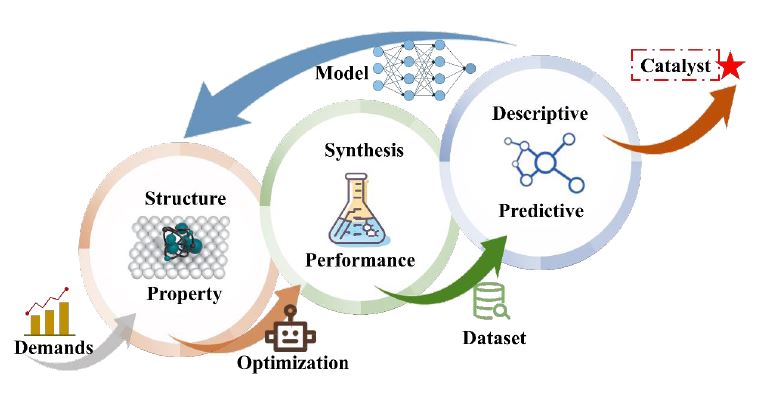
AI technologies are expected to become as powerful tools for addressing the challenges in catalyst design, offering faster and more data-driven approaches for discovery and optimization [7]. AI excels at processing vast datasets, identifying patterns, and predicting outcomes that are difficult to achieve with conventional methods [8]. As shown in Figure 1, the AI-accelerated catalyst design process generates molecular structures and predicts potential material properties based on physical principles and chemical knowledge, while simultaneously exploring the catalyst chemical space through computational simulations. AI is employed to optimize candidate selection and to refine synthesis and preparation conditions, generating data for model training. Catalyst descriptors are then derived, and catalyst performance is predicted using deep learning models. This iterative process, driven by continuous feedback loops, systematically optimizes and identifies the most effective catalyst.
This perspective highlights a broader range of AI-driven advancements in catalyst design. We present case studies where AI has successfully identified promising catalyst candidates and optimized reaction conditions more efficiently than traditional methods. These examples illustrate the practical impact of AI on catalyst design process and illustrate its potential to streamline the development of catalysts with targeted performance characteristics. Our aim is to provide a forward-looking perspective on how AI can contribute to the evolution of sustainable chemistry and address the pressing needs of modern industrial and environmental applications.
AI is not merely a tool for accelerating existing work flows, it fundamentally reshapes how researchers approach catalyst design. Techniques such as supervised and unsupervised learning, neural networks, and reinforcement learning enable the modeling of complex catalytic systems and the prediction of performance based on factors like composition, structure, and reaction conditions. AI has already been applied to discover catalysts for CO₂ reduction, water splitting, and hydrogenation reactions, showing its vast potential [9]. Traditional catalyst discovery involves iterative experimentation, a slow and costly process. AI can streamline this process by predicting catalyst properties from theoretical or experimental data, allowing researchers to focus on the most promising candidates. Machine Learning (ML) algorithms have successfully analyzed large datasets, identifying features that correlate with high catalytic performance, thereby reducing reliance on expensive trial-and-error methods [10]. For instance, an integrated open-source AI-accelerated virtual screening platform was able to screen a library of billions of compounds against two unrelated targets within seven days, predicting docking poses and binding affinities [11]. Additionally, an extrapolative ML approachhas been successfully employed to develop new multi-elemental reverse water-gas shift catalysts with unprecedented accuracy, identifying catalyst compositions beyond the predictive capabilities of human experts [12].
AI’s capabilities extend beyond discovery to optimizing reaction conditions. Variables such as temperature, pressure, and reactant concentrations greatly influence catalytic performance. AI models can explore these vast parameter spaces to identify conditions that maximize activity while minimizing undesired by-products. For example, Bayesian optimization strategies have demonstrated the abilityto identify optimal photo catalysts with iridium-level performance while exploring only 2.4% of the formulation space [13]. Furthermore, AI-powered autonomous laboratories are transforming the catalyst development process. These laboratories combine AI with robotics, high-throughput experimentation, and ML algorithms to autonomously synthesize, characterize, and evaluate catalysts [14]. AI algorithms can analyze the results of these screenings to identify promising candidates more quickly than traditional methods. For instance, the A-Lab platform synthesized 41 novel compounds within 17 days [15]. While an AI-guided global alliance of six autonomous labs identified 21 state-of-the-art organic laser materials [16].
Despite recent advances, AI-driven catalyst design still faces numerous challenges, including those related to data quality, model interpretability, and the integration of AI tools with existing experimental workflows. Understanding these challenges is crucial for advancing the field and ensuring that AI technologies are effectively utilized to address real-world catalytic challenges. One major hurdle is the availability of large, high-quality datasets. ML models require extensive data for accurate training; however, experimental data for many catalytic systems remain sparse. Most available data are limited to simple systems, which reduces the generalizability of models. Overcoming this challenge requires the development of comprehensive databases that encompass a wide range of catalyst materials and reaction conditions, including negative results [17]. Another challenge is the lack of model interpretability. Although AI models predict catalyst performance with high accuracy, they often act as “black boxes”, providing limited insight into the mechanisms driving these predictions. This opacity restricts the rational design of new catalysts, as mechanistic insights are crucial for understanding and improving catalytic performance. Explainable AI (XAI) is gaining traction as a solution [18]. Aiming to enhance the transparent of machine learning models by elucidating how specific features influence performance. Experimental validation of AI predictions also remains challenging. Discrepancies often arise between AI-predicted and experimental results due to factors not captured in the models, such as catalyst degradation or real-world reaction complexities. Integrating AI with experimental workflows through iterative feedback loops could enhance model accuracy and improve experimental outcomes. For example, Closed-Loop Transfer (CLT), which combines closed-loop experimentation with physics-based feature selection, has facilitated the rapid optimization of donor–acceptor molecules while uncovering key chemical insights [19]. The computational resource limitations will be a further key challenge. Training complex AI models, especially those based on deep learning-based approaches, demands substantial computational power, which can be a bottleneck for smaller research groups that lack access to High-Performance Computing (HPC) resources Catalysis involves highly multidimensional systems, integrating data on structure, composition, and performance. To enable broader adoption of AI, it’s crucial to develop algorithms that require less computational power or improve model generalization with limited resources. For instance, a transfer learning approach using pre-trained models, ensemble learning, and active learning has successfully accelerated the discovery of 36 high-performance perovskite oxide electro catalysts, including 13 pure structures [20]. Reducing computational costs or enhancing access to shared resources will be essential for advancing AI in catalyst design.
As AI technologies continue to advance, their role in catalyst design is poised to expand significantly. AI should not be viewed as a replacement for traditional catalyst design but rather as a complementary tool. Combining AI with theoretical and experimental methods will offer a more comprehensive approach to catalyst discovery. For instance, integrating Density Functional Theory (DFT) calculations with AI predictions can refine catalyst structures and reaction mechanisms, thereby enhancing overall design efficiency. The creation of larger and more diverse datasets will enhance AI’s predictive capabilities across a wider array of catalytic systems. By expanding data collection efforts to encompass more complex systems, such as multi-component alloys and nano structured materials, AI models will become more robust and generalizable. Ultimately, the future of catalyst design is likely to be shaped by the rise of autonomous laboratories, where AI will manage experiment design and execution. In these laboratories, AI will continuously refine synthesis and testing protocols, optimizing both catalysts and reaction conditions in real time, without the need for human intervention.
AI is transforming catalyst design, by providing unprecedented speed and precision in discovering and optimizing new catalytic systems. Although challenges such as data scarcity, model interpretability, and computational costs remain, the advantages of AI-driven catalyst design are substantial. As datasets expand and AI models continue to improve, these approaches will increasingly reshape the field of catalysis, making significant contributions to both scientific research and industrial applications.